Retro 2nd Edition |
convert the standard ASL (or similar) game system into a simplified format that emphasizes speed and playability. Its goal is to provide occassional players with easy and straight-forward rules that will allow them to use the game system's components and system modules to experience the "feel" and fun of ASL without having to implement hundreds of pages of rules. This 2nd Ed. is largely unchanged from the 1st edition, except that several optional rules have been added, a section of National Armor Listings has been included, the wording in several sections has been tweaked, and graphics have been improved. The variant presumes that gamers own the regular game rules and components, and is not authorized or endorsed by the publishers of ASL. As such, the variant is not for the gamer who prefers more and more chrome and ever more weapon distinctions, but should appeal to those who think that, at times, "less is acceptable" when it comes to setting up a quick scenario and having some fun. Basic familiarity with the mechanics and terminology of Squad Leader are assumed, and all the boards, counters, and ratings of the SL/ASL system are retained. The variant is, however, adaptable to other tactical game systems, such as Critical Hit's Combat! series. The biggest changes within the Retro variant are: (1) a simplified sequence of play that provides an "I go/you go" format via "hesitation" rolls, and (2) a new a Infantry Fire Table that cuts down on dice rolls by making morale checks unnecessary. For example, two German squads with a firepower of 8 fire on a brush hex containing an American 6-6-6, 6-6-7, and a 9-1 leader. Two dice are thrown on the "8" column of the Retro IFT, and say the final DR is 5; the result of "8" on the table indicate that all personnel in the target hex with a morale rating of eight or less are broken (or are eliminated if already broken). Simple as that. Variant rules cover all the important game areas, such as rallying, stacking, portage, machine guns and other support weapons, ordnance, vehicles, and many other items. Armor combat is likewise simplified. All important factors are considered, such as Gun factor, armor factor, range, and terrain, and the Armor Combat Table will give a single To Kill number; roll this number or less and the target is eliminated. For example, a French B1-bis firing at the side of a German PzKpfwIIF in woods, with a -1 armor leader directing the attack, at a range of 14 hexes, produces a Kill number of 6 (a 42% chance of elimination). The table does not contain endless DR modifiers, and is easy to read. Also included are full instructions on how to construct your own scenarios, DYO Generation Tables, and six scenarios specifically created for the Retro variant. Ideally, Retro should appeal to the gamer who owns some game/historical modules but is not a "lifestyle ASLer". With this variant, the occassional player may utilize all the components of the system without having to worry about a tremendous body of rules. If you prefer simple, classic style wargames, then perhaps you should give this variant a try. (Note: Retro was originally published in several issues of Panzerschreck. These several parts have been combined in one booklet to enable players to access all rules without having to resort to several issues of the journal.) Retro 2nd Ed. comes with a 48-page booklet, two reference cards, and ziplock packaging. See Prices page for current price and postage information. See the Prices page for ordering details. |
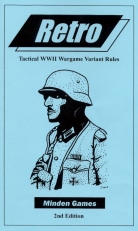
Tactical WWII Wargame Variant Rules |
Retro 2nd Ed. is a simple variant for popular WWII tactical wargames. It consists of a 48-page booklet (plus two reference cards) containing everything you need to |
Click here for a review of Retro. |
